Vicino
Turning Complex Data into Actionable Decisions in AI-Native Marketing Workflows
Helped marketers cut through fragmented data with AI-native analytics and clear information hierarchy, enabling informed decision-making without being overwhelmed by the chaos.

Timeline
May 2026 - Aug 2026
Team
Linda Xiao (Design)
Ricky Song (PM)
Kyle Han (Dev)
Ringkai Sun (Dev)
Tool
Claude Code
Figma
Product
Vicino is an AI-powered marketing platform that connects strategy planning, creative production, social media management, and performance analytics in one workspace.
Problem & Challenge
Fragmented, complex marketing data makes it difficult for marketers to identify meaningful signals, understand performance, and decide which actions are worth taking.
What I did
Designed Market Signals and Performance Analytics to help marketing teams make sense of fragmented data, uncover opportunities, and improve strategies.
Structured complex data analytics through a clear information hierarchy.
Designed AI-native experiences with contextual AI insights and conversational interactions.
Impact
Helped small enterprise marketing teams cut through data chaos, quickly identify what matters, and make informed decisions without having to interpret every metric themselves.
CHALLENGE
Difficult to Make Sense of the Data Chaos
Marketing decisions were informed by fragmented signals across social media, campaigns, competitors, and market trends. With so much information competing for attention, users had to spend significant effort connecting the dots themselves.

So, how might we turn complex, fragmented data into a clear path from insight to action, without overwhelming users?
DESIGN SOLUTION
01
Turning complexity into clarity through well-structured info.
I established a clear information hierarchy that guided users from the most important insight to the supporting evidence, rather than presenting every metric with equal weight.
Weekly Summary → Key Insight → Supporting Data → Detailed Breakdown
By surfacing what mattered first and progressively revealing supporting context, it helped marketers quickly understand what was happening, then explore why it was happening and what to do next, without being overwhelmed by complex, fragmented data.
Weekly Summary
A new report is generated every 7 days, summarizing key data highlights, insights, and performance trends, giving marketers a quick overview of the past week without the need to manually review and synthesize the data.

Key Insights
An AI-generated summary at the top of each analytics tab surfaces key findings and recommended actions, helping marketers respond to performance changes without digging through complex data.

Supporting Data
Next to the recommended actions, supporting insights show the evidence and reasoning behind the recommendations, helping marketers evaluate AI suggestions, build trust, and retain human judgement and control over the final decision.

Detailed Breakdown
Charts and diagrams visualize detailed performance data, while contextual AI insights help marketers quickly understand the key takeaways behind each metric.

02
From insights to action: Understanding performance is only half the job.
Even with a clearer view of the data, marketers still needed to translate insights into strategic decisions.
We introduced AI as a decision-support layer that could analyze patterns across the underlying data and surface potential opportunities. I designed AI insights at two levels:
Strategic overview
An AI insight summary at the top of each section highlighted the most important findings and suggested actions.
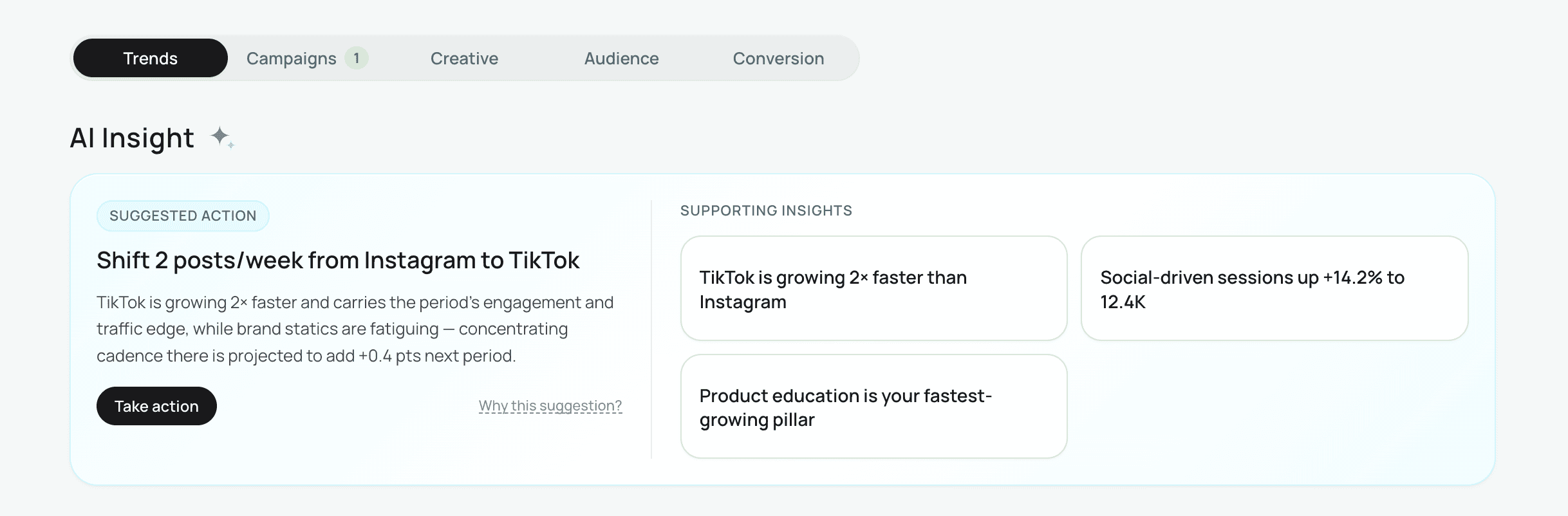
Contextual recommendations
AI insights appeared alongside individual data points, connecting specific performance signals to their relevant recommended actions.

The integration of AI surfaces the most significant insights and highlights what’s worth acting on, so marketers could make informed decisions without having to interpret every individual metric.
03
Balancing AI automation with human judgment: AI recommends. Users decide.
For business-critical decisions, simply giving users an AI-generated answer isn't enough. They need to understand where the recommendation comes from and decide whether it makes sense in context.
I provide accessible evidence and reasoning for every AI recommendation, giving users the context they need to evaluate AI suggestions and make the final decision themselves.

AI helps users identify patterns, synthesize information, and consider next steps. Users remain in control of the final decision.
04
Customizing execution through conversation: From AI recommendations to tailored action.
To ensure a human-in-the-loop decision-making process, I designed conversational AI to help marketers customize how they act on an insight by exploring context, refining recommendations, and adapting strategies to their specific goals.
Through conversation, marketers could modify existing campaign plans or develop new marketing strategies, turning AI guidance into an approach that fits their needs.
TAKEAWAY